Hamdi SHAIKH khalil
A Practical Contract Review Playbook: 10 Things to Check Before Signing Reviewing a contract is not simply about reading the document from beginning to end. A good contract review requires a structured process that helps identify obligations, financial exposure, potential risks, and unclear provisions before the parties sign. Here is a practical framework that can be used as a starting point when reviewing a business contract. 1. Identify the Parties Confirm the exact legal names of all parties. Make sure the names, business entities, addresses, and signing authority are accurate. 2. Understand the Purpose of the Agreement Before reviewing individual clauses, identify what the contract is intended to accomplish. What services, products, rights, or obligations are being exchanged? 3. Review the Scope of Work The scope should clearly describe what each party is expected to provide. Ambiguous descriptions can create disputes later. 4. Examine Payment Terms Review the price, payment schedule, invoices, late fees, taxes, expenses, and any conditions that could affect when payment becomes due. 5. Check the Term and Renewal Provisions Determine when the agreement starts, when it ends, and whether it automatically renews. Automatic-renewal clauses should receive particular attention. 6. Analyze Termination Rights Ask who can terminate the agreement, under what circumstances, whether notice is required, and what happens after termination. 7. Review Liability and Indemnification These provisions can significantly affect the financial risk of the parties. Look for indemnification obligations, liability caps, exclusions, and circumstances where one party may become responsible for another party’s losses. 8. Identify Confidentiality and Intellectual Property Issues Determine what information is considered confidential and who owns work product, intellectual property, documents, data, or other materials created during the relationship. 9. Review Dispute Resolution and Governing Law Check which state’s law applies and how disputes must be handled. The agreement may require negotiation, mediation, arbitration, or litigation. 10. Look for Ambiguity and Missing Provisions A contract review should not focus only on what the contract says. It should also consider what the contract fails to address. Undefined terms, inconsistent provisions, missing deadlines, and unclear responsibilities can create significant problems. Final Review Checklist Before signing, ask: • Do I clearly understand my obligations? • Are the payment terms clear? • Can either party terminate the agreement? • What happens if one party breaches the contract? • Are liability and indemnification provisions reasonable? • Who owns the work product or intellectual property? • What law governs the agreement? • How will disputes be resolved? • Are there any important terms that are missing or unclear? A structured contract-review process does not eliminate risk, but it can make potential issues easier to identify and discuss before an agreement becomes binding. Note: This article is provided for general educational and informational purposes and is not legal advice. Contract requirements and legal consequences may vary depending on the applicable jurisdiction and circumstances.

when-prior-ai-decisions-become-relevant
When Prior AI Decisions Become Relevant An AI system does not need to be the formal decision-maker to affect a legal controversy. It may select facts, summarise evidence, rank authorities or recommend a remedy. If those operations repeatedly react to irrelevant characteristics, the question is not merely whether the model is “biased”. The practical question is whether reliance on that particular deployment should continue. I propose treating this as a functional impartiality challenge. This is not a claim that existing judicial-recusal rules automatically apply to language models. It is a structured way to ask whether an AI evaluator or decision-support system remains suitable for the task assigned to it. Prior outputs can be evidence, but they are not precedents. A single failure may be serious without proving a stable pattern. Comparability matters: model version, system instructions, source bundle, memory state, language, date and procedural posture must be preserved or reconstructed. The audit must also look beyond the final recommendation. Distortion may arise when the system selects facts, assigns credibility, retrieves authorities, frames the issue or changes the remedy. If its earlier summaries later enter memory or retrieval systems, an initial distortion may return as apparently independent support. A proportionate response can include record preservation, controlled counterfactual testing, independent evaluation, exclusion of challenged outputs from memory, an alternate system or human review de novo. High-stakes reliance should stop when the system’s role is not inspectable or genuinely contestable. This is a research framework, not a declaration that a universal doctrine of algorithmic recusal already exists. It is intended to support empirical validation and institutional collaboration. Paper: https://doi.org/10.5281/zenodo.22979245 More: https://estudio.justitia.com.ar


Scripted Knowledge: Are Anthropic's AI Skills Protected by Copyright
Scripted Knowledge: Are Anthropic's AI Skills Protected by Copyright? A close reading of EU copyright law and what it means for a new class of digital artefact In October 2025, Anthropic announced Skills, a new digital artefact that is utilized for prompting tasks that require formalized, procedural instructions. Anthropic defines Skills as “organized folders of instructions, scripts, and resources that agents can discover and load dynamically to perform better at specific tasks” (Anthropic, 2025). Skills cover many domains such as law. Legal Skills are utilized for many legal tasks such as regulatory compliance, legal drafting, research & analysis and so on. These Legal Skills could also be developed and shared openly through online platforms such as Lawve AI. Originality Test for Skills Intellectual property status of Skills is unclear. At the first glance, copyright law seems to be relevant as Skills are mostly text-based instructions that include specific formatting and formats such as YAML frontmatter. Skills could also include code scripts which are written in source code that is accepted as a copyrightable work under the Directive 2009/24/EC the Software Directive. Both text and source code, however, need to reach the originality threshold for them to be protected by copyright law. European Union harmonized the originality threshold in multiple steps. Art. 1(3) of the Computer Programs Directive defined originality as the “personal intellectual creation of the author”. Subsequent case law such as Infopaq (C-5/08, 2009), Bezpečnostní softwarová asociace (C-393/09), Painer (C-145/10), Football Dataco (C-604/10), and Cofemel (C-683/17) further explained the originality requirement in detail. Originality requirement requires Author to have free and creative choices and work to be something more than mere technical instruction. Source code found within Skills are mostly generic, short pieces of functional script that would not include the personal intellectual creation of the developer. This would make them ineligible for copyright protection under the Computer Programs Directive. Even so, they are only the optional part of Skills that are relatively less of an importance compared to the primary part of the Skills, the actual text of the Skills itself. The nature of the text within a Skills is highly formal and instructive. This would negatively impact the possibility of copyrighting Skills, as explained at the Football Dataco Case C-604/10, originality criterion is not satisfied if the work is “dictated by technical considerations, rules or constraints leaving no room for creative freedom”. Saving grace for the originality of Skills here would be the expression of the writers’ specific expertise and legal judgement in a personalized, unique manner: the more personal expertise expressed in a Skill that differentiates it from generic, standardized legal instructions, better the chances for copyright protection for such Skill. It would also help if the authors style of instruction and writing is also unique and differentiated from general Skills template as much as possible. Open-Source Licensing of Skills Another relevant and important issue for legal Skills, specifically publicly available legal Skills found in platforms such as Lawve AI would be the licenses that govern the share and use of Skills. Unfortunately, the most urgent and glaring issue for licensing Skills is that none of the open-source licenses would be applicable and valid for the Skills, even if they have been widely used by many authors. Open-source licenses such as permissive and copyleft licenses (MIT, AGPL-3.0 etc.) are specifically designed for governing source code and object code. Creative Commons licenses are legally appropriate and sufficient for Skills and they have been created precisely for this reason. As mentioned above, source code found within the scripts would most likely not pass the originality criterion. If the text of Skills does pass the originality criterion, it would be legally valid to license it under a Creative Commons license rather than an open-source license. Conclusion Skills are one of the many digital artefacts that appeared with the advent of generative AI models. They are at the frontier of intellectual property, pushing the boundaries of traditional classifications and existing licensing frameworks. This requires, just as with many other domains, a creative and innovative approach to understand and utilize them. And they will definitely not be the last piece of digital artefact that will challenge the existing legal structures. Bibliography Anthropic (2025). Introducing Skills. Anthropic. https://www.anthropic.com/news/skills Directive 2009/24/EC of the European Parliament and of the Council of 23 April 2009 on the legal protection of computer programs (codified version) [2009] OJ L111/16 (Software Directive). Case C-5/08, Infopaq International A/S v Danske Dagblades Forening [2009] ECR I-6569. Case C-393/09, Bezpečnostní softwarová asociace – Svaz softwarové ochrany v Ministerstvo kultury [2010] ECR I-13971. Case C-145/10, Eva-Maria Painer v Standard VerlagsGmbH and Others [2011] ECR I-12533. Case C-604/10, Football Dataco Ltd and Others v Yahoo! UK Ltd and Others [2012] ECLI:EU:C:2012:115. Case C-683/17, Cofemel – Sociedade de Vestuário SA v G-Star Raw CV [2019] ECLI:EU:C:2019:721.

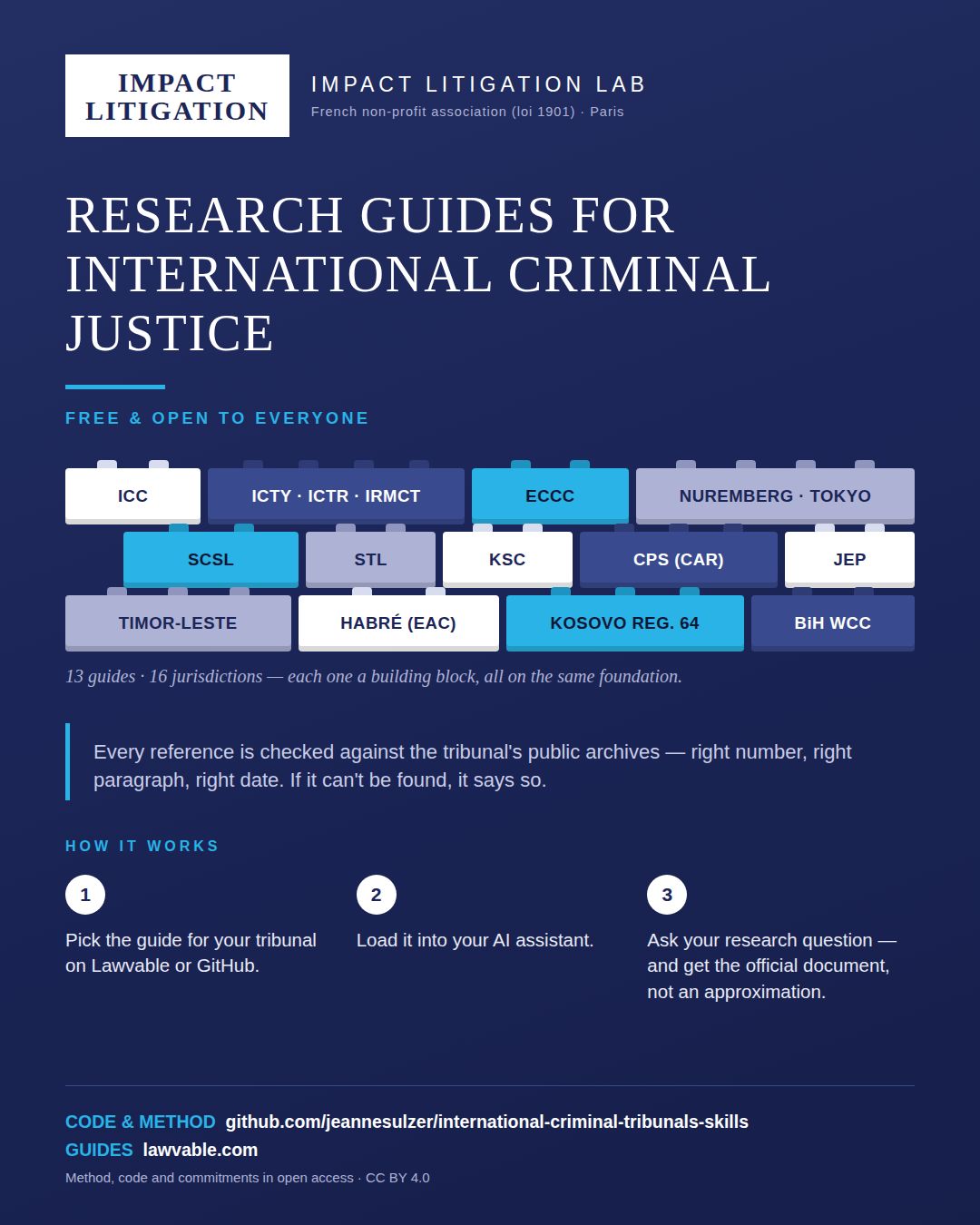
Research tool for international criminal justice
We've just released a research tool for international criminal justice. It is free and open to everyone. International tribunals — the ICC, the tribunals for the former Yugoslavia and Rwanda, the Khmer Rouge tribunal, Nuremberg, Tokyo, and a dozen others from the Kosovo Specialist Chambers to the JEP in Colombia — publish their judgments and archives. Everything is public but finding your way through them is sometimes difficult and some websites are genuinely hard to access. So we built, for 16 jurisdictions, research guides designed to be used with an AI assistant. The rule behind them is simple: the assistant is not allowed to cite a judgment from memory. For every reference, it must locate the official document in the tribunal's public archives. If it can't find it, it says so. This is a project of Impact Litigation Lab, a French non-profit association (loi 1901) and the pro bono lab of my law practice, created to help make international human rights law and international criminal justice effective for victims, civil society organisations, human rights defenders, practitioners, researchers. Everything is freely available For the more technical readers: the whole suite also comes as a ready-made connector (an "MCP server") that plugs it directly into AI assistants & everything is on GitHub: 📂 https://github.com/jeannesulzer/international-criminal-tribunals-skills 📚 The guides, ready to use, on Lawve AI ai : https://lawve.ai

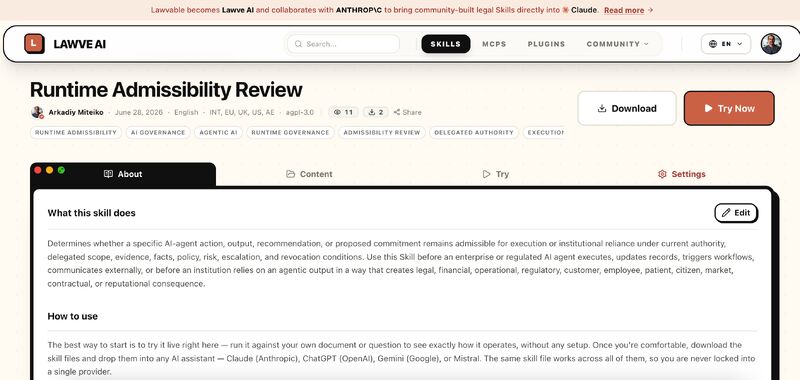
Runtime Admissibility Review Skill
Agentic AI governance does not end when an agent is authorized. That was the point of the Agent Authority Charter Builder I recently contributed to Lawve AI. The Charter answers the first question: What was the agent authorized to do before it acted? But in real institutions, authority is not static. -Facts change. -Policies change. -Evidence changes. -Risk conditions change. -Delegations expire. -Escalation triggers appear. -Reliance conditions shift. That creates the harder governance question: Even if the agent was authorized, is the action still admissible now? I’m pleased to share that my second Lawve AI skill is now live: Runtime Admissibility Review It helps legal, compliance, risk, audit, operations, and AI governance teams determine whether a specific AI-agent action, output, recommendation, or proposed commitment remains admissible under current authority, scope, evidence, policy, risk, escalation, revocation, and reliance conditions. This is the missing runtime layer. Because agentic AI governance cannot stop at deployment approval. A properly authorized agent may still become inadmissible before execution or before institutional reliance if the surrounding conditions change. The Skill is designed to produce a structured Runtime Admissibility Determination, including: • standing authority review • scope review • current-state review • evidence sufficiency review • constraint and policy check • escalation trigger review • human approval review • revocation / suspension / kill-switch review • reliance / consequence review • final admissibility decision This creates a governance chain: Agent Authority Charter → Agentic Delegation Audit → Runtime Admissibility Review → Institutional Reliance / Consequence The Charter defines the authority envelope. Delegation Audit tests the delegated task against that envelope. Runtime Admissibility asks whether the action or reliance remains justified at the point of use. That distinction matters. Authority before action. Admissibility before reliance. Evidence before consequence. Escalation before harm. Agentic AI will not scale in serious institutions on intelligence alone. It will scale on recognizable authority, controlled execution, and evidence that survives review. Next in the sequence: execution evidence. Live now here!

AI Daily Digests
AI daily digests or to-do lists are the most obviously useful LLM feature almost nobody actually has or talks about. I've been getting one every weekday morning for some time now and it's one of the most helpful things Claude does for me. Agentic LLMs like Claude Cowork are especially useful for practical items like a daily digest, particularly if they can look through relevant news sources and your emails. These digests are very personal, so a general pre-built skill or tool won't help you much, and building one yourself takes time and effort. One other bottleneck is that Outlook doesn't let Claude (or any other LLM) create emails or calendar events. Getting the digest onto your screen automatically each morning is tricky. I realised there are three workarounds that work, and wrote a guide anyone - whatever work you do - can use. You attach the guide (MD file) to a Claude Cowork chat, ask Claude to follow it, and answer its questions. Claude then: (a) builds you a personalised daily-digest skill based on your news sources, emails, Teams messages, whatever you want; and (b) sets up a scheduled task so the digest lands on your screen automatically (in Outlook or your browser) every morning. I use it every day, and find it really helpful to have a "Claude Cowork powered" to-do list in my calendar. The guide uses the structure and mechanics of my own (heavily tested) daily digest skill, so hallucination, 'drifting' and missing-context risk is low.

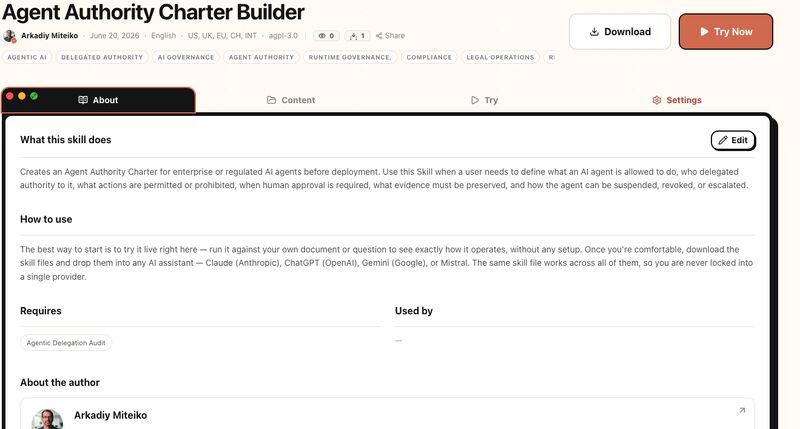
Agent Authority Charter Builder Skill
Agentic AI governance starts with one question: What was the agent authorized to do before it acted? I just contributed a new Lawve AI Skill: Agent Authority Charter Builder. It helps legal, compliance, risk, and AI governance teams define an agent’s delegated authority before deployment: permitted actions, prohibited actions, human approval rules, escalation triggers, evidence requirements, suspension/revocation controls, and deployment-readiness status. This is the control layer many organizations are missing. Because once agents begin updating systems, triggering workflows, recommending decisions, or executing bounded actions, governance cannot remain abstract. The institution needs a clear authority artifact before execution. Not just model safety. Not just policy review. Not just audit after the fact. Authority before action. Evidence before reliance. Escalation before harm. Live now on Lawve AI! This is the first in a sequence. Next, I plan to publish four companion Skills that extend the same governance thesis: Runtime Admissibility Review: To determine whether a previously authorized AI action is still permissible under current facts, policy, authority, and evidence conditions. Execution Evidence Pack Generator: To produce a structured audit artifact showing what the agent did, why it was allowed to act, what evidence it relied on, and who approved or escalated the action. Regulated AI Pilot / Sandbox Waiver Pack: To help financial institutions, insurers, healthcare organizations, and protocol suppliers prepare regulator-facing pilot proposals for controlled agentic AI deployment. AI Vendor Runtime Governance Due Diligence: To evaluate whether an AI vendor can safely operate inside an enterprise control environment, including authority boundaries, escalation logic, evidence generation, auditability, and revocation controls. Together, these Skills are designed around one premise: Agentic AI will not scale in serious institutions on intelligence alone. It will scale on recognizable authority, controlled execution, and evidence that survives review.
Gouvernance des sociétés cotées françaises
J'avais une idée : rendre la gouvernance des sociétés cotées accessible à tous, en particulier dans le cadre de mes travaux de thèse. 🎓 Près de deux mois de travail. Des itérations, des lectures et des relectures à n'en plus finir. Voilà le résultat : un skill d'analyse documentaire sur la gouvernance des émetteurs cotés français — corpus AMF et HCGE 2020-2025, Code AFEP-MEDEF, sources légales et européennes. 📚 Des recherches que je mettais des heures à faire quand j'étais en cabinet, effectuées par une requête adossée à un skill solide (et un Claude by Anthropic que je ne cesse de pousser dans ses retranchements). Comme rien n'est parfait, je vous invite après chaque livraison à faire auditer le résultat des travaux par un agent hors skill avec le prompt que je vous propose en second commentaire. Exemple concret : les votes say on pay entre 2020 et 2025. Quels votes ont été rejetés ? À quel taux ? Sur quel périmètre ? L'outil restitue les faits avec leur source et leur page — 13 résolutions rejetées au CAC 40 en 2021, 33 contestées en 2024 dont 19 sur la rémunération, Stellantis à 52,12 % de rejet en 2022. Et quand la donnée manque, c'est dit ✅ J'ai testé la même question sur trois IA généralistes. Des réponses fluides, bien structurées — et des chiffres introuvables. Le skill, lui, sort la page exacte et l'agent d'audit vérifie les résultats (j'ai laissé subsister exprès une imprécision pour que vous puissiez voir le résultat attendu). Cet outil n'aurait pas été possible sans la diffusion des rapports de l'Autorité des marchés financiers (AMF) – France et du HCGE (cc L'Afep), qui documentent chaque année les exigences croissantes pesant sur les dirigeants des sociétés cotées. C'est une des vertus de la régulation / l'auto-régulation des marchés financiers : permettre l'accessibilité à une quantité importante et pertinente d'information sur la gouvernance. Merci à eux 🙏 L'outil est open source sur Lawve AI, gratuit, et surtout non commercial pour favoriser l'enrichissement scientifique autour des sujets de gouvernance des sociétés cotées.

Settlement Strategy Assessment Skill
A lot of settlement strategy depends on how well you understand your own position, and how well you can assess the other side’s willingness to settle. It is not just about the number. It is about the pressure points sitting underneath it: merits, evidence, costs, timing, leverage, uncertainty, risk appetite, and what each side thinks happens if settlement does not happen. That is what my settlement pressure tester skill is designed to help with. It stress-tests a proposed settlement position by looking at things like: – how strong the case actually is – what assumptions the position depends on – where the evidence is uncertain – what leverage each side may have – how the other side is likely to respond – how timing and costs affect the strategy It does not tell you whether to settle - that remains a legal and commercial judgment. But it helps make the underlying pressures more visible before an offer is made.

Contract Intelligence and Workflow Reviewer
I published an AI skill on Lawve AI: Contract Intelligence & Workflow Reviewer This started as a contract review skill and evolved into an experiment: How far can an LLM be pushed toward Contract Lifecycle Management (CLM) capabilities? The skill includes: • Structured intake • Playbook normalization • Clause-by-clause review • Deviation scoring • Negotiation planning • Approval routing • Workflow states • QA & benchmarking • Actions I wanted to explore where AI models are useful and where they fall short. LLMs are very good at: • Contract intelligence • Issue spotting • Negotiation support • Playbook comparison • Workflow guidance • Drafting • Contract review But they struggle with CLM capabilities, including: • Persistent records • Structured metadata • System-of-record • Workflow engines • Obligation management • Reporting & analytics • Enterprise integrations • Governance/controls AI helps people do contract work. It can support parts of the contract lifecycle. It is not yet a CLM. Harvey and Legora continue expanding contract review and workflow capabilities. CLM vendors such as Conga, Ironclad, Agiloft, Icertis, Docusign, & Sirion continue to embed AI in their platforms. Contract AI vendors such as Ivo, Spellbook, Luminance, & DocJuris are expanding their capabilities. Anthropic is expanding Claude through Skills, agents, workflows, MCP, and document analysis. OpenAI appears headed in a similar direction. As capabilities once requiring specialized contract AI products increasingly become available from the platforms, the question becomes: what remains differentiated? My suspicion is that contract review is becoming a feature rather than the product. The competitive advantage increasingly comes from workflow, governance, integrations, knowledge, playbooks, data, controls, and adoption. The model matters, but execution matters more. A lesson from this project: this skill can consume a lot of tokens. When using an LLM to replicate aspects of a CLM, large agreements, playbooks, comparison reviews, and detailed reports can result in significant token consumption and cost. I intentionally optimized this skill for thoroughness and process over efficiency because I wanted to understand the limits. If you never use this skill, there may be useful ideas in the design related to: • Legal AI strategy • Contract intelligence & operations • CLM modernization • Legal workflow automation • The future of legal service delivery I’m exploring my next leadership opportunity. If you know of a relevant role, please reach out.

Latin American Litigation Skill in Spanish
It’s no secret that most AI models are US/Europe-centered, and although they work wonderfully, their use in local legal contexts, especially in Latin America, can be limited or even risky from a legal standpoint. So, I took the opportunity to create a fully Spanish-language Skill for litigation processes in Latin America, and it’s available on Lawve AI 🧠!!! This skill is designed to assist litigators, in-house legal teams, and direct clients with procedural strategy, risk analysis, and guidance on civil procedure across Latin America. It covers 18 jurisdictions, uses mandatory local terminology, automatically detects deadlines at risk, and also drafts a simple-language email at the end of any analysis that can be sent directly to your client. You can download it and use it inside your favourite AI tool by adding legal documents, case notes, or even plain-language descriptions. From there, the skill guides you through the process. Any feedback is always welcome! 🙏 If you try it, let me know what you think!

Disclosure Strategy Mapper Skill
I recently built a disclosure strategy mapper. The idea is simple: you give it a case summary, pleading, chronology or issue list, and it helps you think through the documents that may matter. It maps things like: – likely document categories – potential custodians and sources – adverse material that may exist – evidential gaps – search themes – privilege or sensitivity flags – disclosure risks I wanted something that could help with the early-stage thinking that often sits behind litigation strategy. What documents would we need to prove this? Where are they likely to be? Who might hold them? What might undermine the case? What are we assuming exists, but have not yet found? It is not a substitute for applying the relevant disclosure rules, of course. But it is a tool to help you structure your thinking.