Reaching 110 Legal Skills
When Antoine Louis and I created the Lawve AI (prev. Lawvable) hub last Christmas to share Agent Skills for law, and I uploaded the very first 2 skills to it, I would never have imagined seeing that number grow to 110+ in less than 4 months. I’m really excited to announce that we’re now officially collaborating with Anthropic to make these skills accessible directly inside Claude. The hub today has become a trusted gateway to legal AI resources (skills, MCPs, plugins). 35K+ people from around the world visit it every month, and that number keeps growing. I couldn't be happier to see this community effort come to life, and even more so to play a small part in it by helping build the hub. I've been talking to Antoine about this idea of a 'Hugging Face for law' for years. A place where practicing lawyers, in-house counsel, law professors, and legal technologists all share legal knowledge and build on top of it. That's how I always wanted law to be: open, accessible, and actionable. Seeing Anthropic support this effort and reinforce our mission to make these tools as accessible as possible to legal professionals fills me with joy. With our official MCP connector, every Claude user on Earth can now access the legal expertise shared publicly on the hub, directly inside Claude Cowork or Web. Imagine that: Claude, on top of its extraordinary reasoning capabilities, now has the precise legal context for a given task in a given practice area or jurisdiction, uploaded by a domain expert. I want to give a massive thank you to the Anthropic team for their trust and support, in particular Mark Pike, Hadley Mouritzen, and Ancy Dow. And above all, I want to thank all the professionals contributing to making law and its automation more accessible. You're the heart of this. For anyone discovering the project and curious about how to contribute, feel free to reach out! I'm more than happy to guide you through what can look like complex topics at first. Big year ahead, so exicted to see where the lawve.ai project goes!

Anonymizing Data Before Claude
Wouldn't it be cool if you could chat with Claude knowing everything you send is automatically anonymized? That's the question that keeps popping up in my head as I give Claude more and more access to tools and data. The power of a frontier model on your data with zero PII. That would be the dream. So I spent a beautiful sunny weekend locking myself in front of my computer to try making that work. Here's how I approached the task: 1. Take an open-source entity recognition model that can spot all personal data in a document (names, locations, phone numbers, etc.). I'm using GLiNER, a state-of-the-art model small enough to run fully locally in a matter of seconds. 2. Replace all detected entities with a placeholder (e.g. [PERSON1], [LOCATION2]) - so yes, technically it's pseudonymization - and save that mapping locally on your computer. 3. Put all that logic into a "hook", a mechanism supported by all major AI providers that lets you run deterministic scripts at certain events during an interaction with the AI agent. This is what makes the whole process automatic. See, when I ask Claude to work on a document, it typically starts by triggering a Read operation. The hook intercepts that operation before your original data is sent. It runs the pseudonymization and feeds the cleaned text back to Claude. All of that happens without you needing to do anything. Claude reasons over the pseudonymized content and never sees the original data. In theory, it works. But I already noticed some limitations worth sharing (and I'd welcome some guidance if any of you have ideas). First, Claude can read files in many creative ways beyond the Read operation I initially hooked into. Bash commands, python-docx, pandoc, even custom scripts written on the fly. Every time I think I've covered all the patterns, Claude surprises me with a new way of getting its hands on the original content. It's a bit of a cat-and-mouse game. Then, the quality of detection. Even with the best model, some personal data slips through and some gets flagged when it shouldn't. For example, some street addresses were missed entirely until I added an extra rule-based check on top. Which makes me think the right approach is combining different tools rather than relying on a single one. Not production-ready. Still a lot to clean up. But a problem worth solving in the open (and one that definitely feels solvable). Shoutout to Jonas Achermann for his open-source anonymization tool (link in comment). And for those curious about the setup in the demo below, it's Lawve AI's VSCowork - a setup that turns VS Code into a minimal AI workspace ready for legal work.
Claude Plugins for Legal Work
Anthropic recently released plugins for Claude. I have mixed feelings about the concept. Plugins let you bundle multiple Agent Skills into a single installable toolkit. That idea makes a lot of sense, especially in legal. Say you're reviewing NIL contracts for student-athletes. You can now combine Samir Patel's NIL Contract Analysis with Rafał Stanisław Fryc's Statutory Interpretation to properly analyze the underlying state laws. Expert knowledge from different domains packaged as one toolkit. After few requests, we’ve integrated a "Build Your Own Plugin" on Lawve AI. Pick the legal skills you want, and the system packages them into a ready-to-use Claude plugin with all dependencies included automatically. Hit download, drop it into Claude Code or Cowork, and start working. Pity that the plugin format itself isn't being standardized the way skills are. A skill you write today runs on Claude, GPT-Codex, Gemini, Mistral, and dozens of other tools without changing a single line. That interoperability is so valuable in my opinion. Let’s hope plugins get there too someday. In the meantime, the skills underneath remain open and portable.
Outlook to Redlined Contract
I built an Outlook integration for Claude Code. Today I can go from email to redlined contract in one message. Claude reads my Outlook inbox, finds an NDA review request, downloads the attachment, analyzes it clause by clause, and outputs a Word document with tracked changes and comments. One message. Four skills working together. This is what I'm most excited about with Skills. Orchestration. Each skill does one thing well. Chain them together and you get real automation. Right now it's read-only. Connecting your email to an AI agent deserves caution. But you can configure broader access if needed. If you want persistent login, it's possible. No token caching for now, so you reconnect every time. The Outlook skill is free and open-source on Lawve AI. Link in the comments. And of course, huge thanks to the SuperDoc team for their incredible work on the editor!
Building Reusable Legal Skills
I've been building 10+ AI legal Skills over the past month, so I wrote a guide that documents exactly how I build them, from scratch to something reusable. What goes into a Skill. How to break down a complex task so the AI doesn't mess it up with reliable sources. How to chain Skills together. How to improve them over time. This is just my methodology and it’s not perfect. It could probably be improved in many ways. But if it helps someone get started, that's good enough! If you're a legal professionals who wants to build your own AI Skills without any tech background, this might be useful. Thanks to everyone contributing open-source Skills on Lawve AI. A lot of this came from watching what others built and learning from it.
Testing Cowork for Legal Review
Anthropic just released Cowork. It's Claude Code, but for everyone. I wanted to see what it could do for legal work. So I tested a Skill for tabular review, one of Legora's most loved features. The setup: a small legal data room. Corporate filings, commercial contracts, employment agreements, IP assignments. The task: extract parties, dates, terms, and governing law from each document. Output to Excel with citations. Claude launched 5 agents in parallel. Each one took a batch of documents and extracted all four fields simultaneously. No scripting. No configuration. The orchestration was automatic. The output: a structured Excel matrix with one row per document. Every extracted value includes a page number and a source quote. Hover over any cell to see exactly where the information came from. It's genuinely impressive. But there are limits. The mock data room had 13 small documents. A real one might have 200+ files, some running to hundreds of pages, robust parallelization will be essential. PDF quality matters too; Claude's native parsing isn't perfect yet. And then there's confidentiality: Cowork on Claude Desktop sends data to Anthropic's servers. Use with caution for sensitive matters. For cases where you need more control over hosting and data residency, alternatives exist. Claude in VS Code lets you connect to third-party cloud providers (Google, Microsoft, etc.) that offer stricter data agreements for enterprise requirements. Antoine Louis recently documented how to set up VS Code for non-coders and it has become my default setup since then. This demo is a quick look at what's possible with Claude Cowork. And it's good. But as with any LLM, trust but verify. That's what the citations are for. It's not perfect yet, but it might be useful for bulk-analyzing a small sample of documents. If you're curious about how Skills work or want to create your own, happy to help. A good starting point I recommend is the Lawvable hub.
Improving Legal AI Workflows
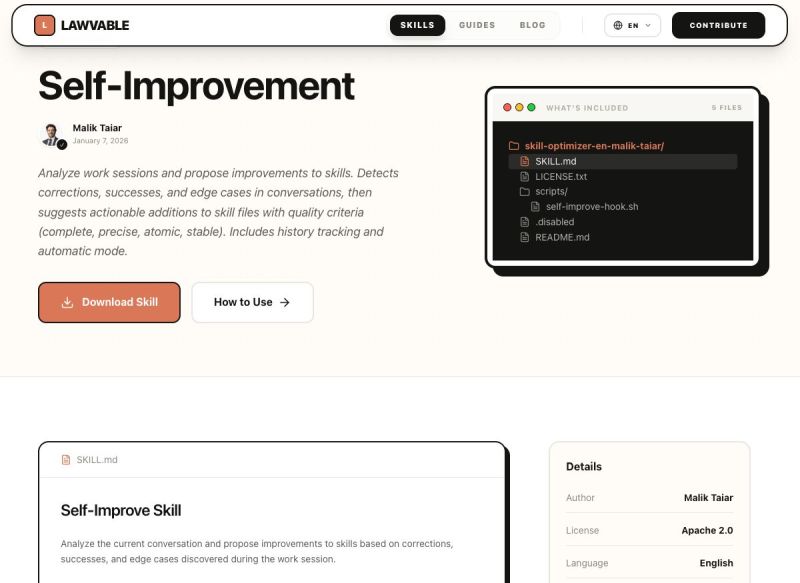
2 months ago I was fixing the same AI mistakes over and over again. Today my legal AI workflows improve automatically every time I use them. Every correction I make gets captured, evaluated, and added permanently. And this thanks to Agent Skills. Skills are like onboarding a new employee. You give them your templates, explain your approach. They follow your methodology. But a real human learns from your corrections. Skills don't by default. They are static. You correct Claude, it works, next session using that skill: same mistake. For example, say you use the NDA Review skill built by Jamie Tso, notice Claude missed something, and ask to fix it. The next day it will make the same mistake. The correction is gone. So I made a skill that makes Claude self-improve automatically. At the end of a work session, it scans the conversation for your corrections, checks if they're specific enough to be actionable, and proposes updates. One click to approve. The skill remembers it as long as you want. Everything is stored in a history file that tracks every modification in plain language. If you want to revert to a previous version or share the skill with a colleague, they can see exactly what changed and why. The skill becomes your dedicated AI workflow. It improves with your practice without you having to manually edit anything. The skill is free and open-source on the Lawvable hub. Download it here and start using it today.
Legal Services as Software (LSaaS)
For more than a decade, legal technology made legal professionals more efficient without touching the legal service itself. This could change soon. Traditional platforms focused on administrative tasks such as document storage, billing, case management, corporate secretarial work. Research databases like Westlaw and Practical Law came closer to legal analysis by surfacing precedents and statutes, but they deliver raw materials, not drafting or reviewing legal documents from scratch. Integrating AI to the same features With the rise of LLMs, vendors added AI to what they already sold. Summaries instead of raw court decisions. Synthesized answers instead of search results. Automated tagging instead of manual classification. The infrastructure remained the same, the output just got faster. As LLMs demonstrated they could draft and summarize at scale, generative AI was supposed to reduce working time drastically, make deliverables more predictable and bring costs down. But AI legal softwares weren't delivering on that promise. As Jordan Bryan recently wrote, "many lawyers report these products aren't reliable enough for them to trust and don't do much more than ChatGPT." AI features accelerated the margins, they didn't touch the core of legal work. Distribution came first Why did vendors ship incremental features instead of tackling the service itself? The answer, as Bryan highlights, lies in incentives. Whoever captured market share before the technology matured would own the market when it did. The strategy was to reach as many clients as possible, not product quality. Legal tech companies positioned themselves as trusted partners for the years ahead. When firms subscribed to Legora or Harvey, the bet was less about immediate competitive advantage and more about backing the right horse before the technology matures. Distribution first, product consolidation later. From tools to services The end users don't want a clause-by-clause comparison table. They want their shareholder agreement drafted. The service itself is becoming the product. Legal tech startups scaled products first to lock in clients. Now they're scaling services - where the real value lies. They are building orchestration capabilities into their platforms, inviting lawyers and clients to create workflows, share them, and make the platform the hub for legal service delivery. In June 2025, Harvey launched Workflow Builder, a tool that lets legal teams create custom AI-powered workflows without code. Over 18,000 workflows have been created since launch. The same month, Legora introduced Workflows, an agentic framework that orchestrates multi-step legal tasks, calling on multiple tools and data sources in a single sequence. These platforms are moving beyond features toward full service orchestration. They're hiring experienced lawyers to encode expertise into their systems. And they're repositioning how services reach end users. Harvey introduced Shared Spaces in December 2025, allowing firms to collaborate with clients directly through the platform. Legora is launching white-label client portals in early 2026, connecting both sides of the legal relationship, lawyers and clients, within a single environment. They now control both workflow creation and distribution. Some are positioning to avoid intermediaries, keeping control over the entire value chain. Crosby, an AI-native law firm in the US, builds services while retaining distribution. But not everyone can build a firm from scratch. Scaling alone is hard. Workflow creation, distribution, maintenance, deployment require resources most practitioners don't have. In many jurisdictions, law firms face restrictions on raising external capital, making it difficult to compete with well-funded legal tech platforms. The agentic turn Foundational model providers offer alternatives that may prove more robust. They sit at the source. Anthropic's Skills standard offers something different. A Skill teaches an agent how you work. The analogy is training a new associate. You share templates, explain methodology, provide reference resources, guide step by step. A Skill packages that for an AI agent. Expertise encoded once, applied consistently. This allows the entire sequence to be defined. From a tailored intake through document analysis, legal research, and draft production. No step left implicit. The workflow becomes executable and you can create it yourself. Skills and native orchestration through tools like Claude Code are not just alternatives. They are becoming the standard for agentic AI. They manage context and agent orchestration, which is the hard part. When Meta acquires Manus for two billion dollars, it signals how difficult it is to replicate these capabilities. Foundational model providers will likely remain best positioned to advance these agentic systems. They're the safer long-term bet. Of course, legal tech platforms offer more than orchestration. Data security certifications, compliance frameworks, enterprise integrations, dedicated support. For large firms and corporates with strict data governance requirements, these guarantees matter. But alternatives may emerge. Skills make orchestration accessible without platform subscriptions. Security and compliance tooling is still maturing. If these tools reach enterprise-grade standards, lawyers could package and distribute their expertise directly. Who captures the value? The question is now open. Legal tech companies are likely to capture the service layer for large corporates. They have the infrastructure, the capital, and they're already embedding into enterprise legal departments. AI platforms like OpenAI, Anthropic, and Google add another layer. They're becoming the entry point for legal questions, capturing demand at a scale neither firms nor vendors built. And the market is fragmented. Mid-sized companies with one in-house counsel managing everything. Small businesses with occasional needs. Each segment consumes legal services differently. Understanding who needs legal services, where they are, how to reach them will become critical. Innovating on distribution will matter as much as innovating on the service itself. It's also worth noting that AI won't just redistribute value. It will probably expand the market. By surfacing legal risks no one identified before. By raising awareness of existing ones. By creating new risks altogether. --- The transformation was probably never about buying better software, but about how value gets redistributed when AI reshapes an industry. Who builds, who distributes, who captures?