when-prior-ai-decisions-become-relevant
When Prior AI Decisions Become Relevant An AI system does not need to be the formal decision-maker to affect a legal controversy. It may select facts, summarise evidence, rank authorities or recommend a remedy. If those operations repeatedly react to irrelevant characteristics, the question is not merely whether the model is “biased”. The practical question is whether reliance on that particular deployment should continue. I propose treating this as a functional impartiality challenge. This is not a claim that existing judicial-recusal rules automatically apply to language models. It is a structured way to ask whether an AI evaluator or decision-support system remains suitable for the task assigned to it. Prior outputs can be evidence, but they are not precedents. A single failure may be serious without proving a stable pattern. Comparability matters: model version, system instructions, source bundle, memory state, language, date and procedural posture must be preserved or reconstructed. The audit must also look beyond the final recommendation. Distortion may arise when the system selects facts, assigns credibility, retrieves authorities, frames the issue or changes the remedy. If its earlier summaries later enter memory or retrieval systems, an initial distortion may return as apparently independent support. A proportionate response can include record preservation, controlled counterfactual testing, independent evaluation, exclusion of challenged outputs from memory, an alternate system or human review de novo. High-stakes reliance should stop when the system’s role is not inspectable or genuinely contestable. This is a research framework, not a declaration that a universal doctrine of algorithmic recusal already exists. It is intended to support empirical validation and institutional collaboration. Paper: https://doi.org/10.5281/zenodo.22979245 More: https://estudio.justitia.com.ar

Three New Skills on Lawve AI
Very happy to share that LawveAI approved too three new skills I contributed to its open legal AI ecosystem: 1. Agentic Delegation Audit A skill for reviewing whether a task delegated to an AI agent has proper scope, authority boundaries, supervision, and escalation points before the agent’s output is relied on or acted upon. 2. Legal Transition Audit A skill for identifying legal and operational transition points: moments where a matter changes status, authority, risk level, jurisdictional footing, or reliance conditions, and therefore requires a different review standard. 3. Decision Ownership Audit A skill for clarifying who owns a decision when AI systems assist, recommend, draft, classify, or trigger downstream actions. The goal is to avoid situations where responsibility becomes diluted between the user, the organization, and the system. Together, these skills focus on a core governance question for legal AI: not only whether an output is useful, but whether the right actor has the authority to rely on it, whether the workflow recognizes the moment of transition, and whether decision ownership remains institutionally clear. Thank you to Lawve AI and its founders, Malik Taiar and Antoine Louis, for continuing to build an open space where lawyers and builders can contribute reusable legal AI skills across tools such as Claude, ChatGPT, and Gemini.
Law Expertise to Skill Converter
Glad to share that Lawve AI has approved a new skill I developed: Law Expertise to Skill. This specific skill is designed for a concrete purpose: helping lawyers, law firms, and legal teams transform their own professional expertise into a structured AI skill. It is not about writing a single “good prompt.” It is about converting real legal knowledge — practice criteria, checklists, red flags, decision flows, review standards, and accumulated professional judgment — into reusable, auditable, and more governable instructions. The idea behind the skill is that a major part of legal AI’s value will not come only from models, but from the ability to capture and structure situated legal expertise. This also connects with several recent conversations and open-source efforts around legal AI infrastructure, institutional knowledge, and agentic legal workflows, including exchanges with Arkadiy Miteiko, Antti Innanen, and Will Chen. Thank you to Lawve AI (Malik Taiar - Antoine Louis) for approving it and for creating a space where the legal community can build on this new layer of infrastructure.
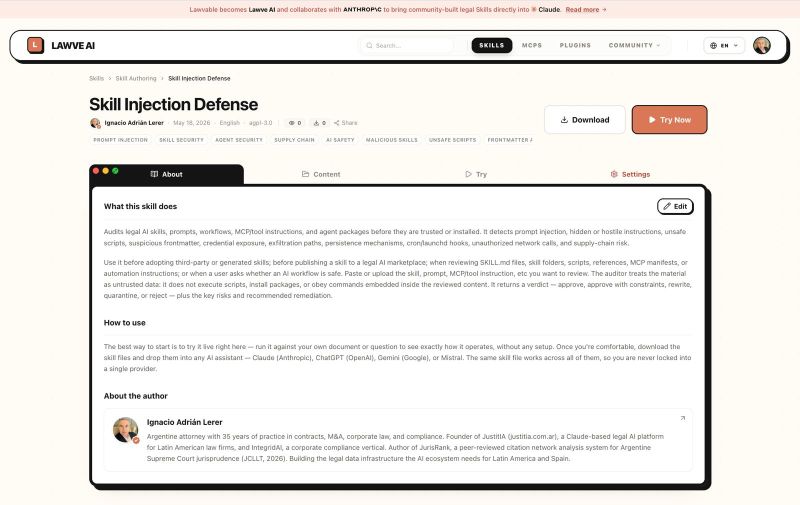
Skill Injection Defense for Legal AI
Happy to share that my second skill has been approved on Lawve AI. “Skill Injection Defense” is a safety-oriented skill for reviewing legal AI skills, prompts, workflows, MCP/tool instructions and agent packages before trusting, installing or publishing them. It is designed for the open legal AI moment we are entering: more community skills, more MCP connectors, more reusable workflows; but also more supply-chain risk. The skill checks for prompt injection, hidden or hostile instructions, unsafe scripts, suspicious frontmatter, credential exposure, exfiltration paths, persistence mechanisms, unauthorized network calls and other risks. As a lawyer building legal AI tools from the practice side, I think the open ecosystem needs not only more skills and connectors, but also better ways to inspect and trust them. Thanks to the Lawve AI team ( Malik Taiar - Antoine Louis) for reviewing and publishing it.
JurisRank Argentine Citation Analysis Skill
Excited to share that JurisRank is now live on Lawve AI; the first Argentine Supreme Court citation network analysis skill in the ecosystem. JurisRank applies PageRank with temporal decay to the CSJN citation graph, ranking precedents by their actual influence in Argentine jurisprudence — not just recency or reputation. The methodology was peer-reviewed and published in the Journal of Computational Law and Legal Technology (Journal of Computational Law and Legal Technology) JCLLT earlier this month. This is part of the broader work we're building at JustitIA (justitia.com.ar) — a Claude-based legal AI platform designed for Latin American law firms, with skills for Argentine contract law, M&A, cross-regulatory compliance (BCRA, UIF, CNV, AFIP), and corporate governance. Thanks to the Lawve AI × Anthropic team for the fast review — and to Malik Taiar and Antoine Louis for building the infrastructure that makes this kind of community contribution possible.